
Threats Without Borders Newsletter
Friday Morning Brief - September 12, 2025
Hi, it’s Matt. Wait, what? I know it’s Friday, and I shouldn’t be in your inbox until Tuesday.
But I ask your mercy for some special news.
I’ve been publishing the Threats Without Borders newsletter for nearly five years. For a while, I thought that Substack's promotion tools were not fully available because the newsletter is free, which has limited its growth.
Recently, others have supported this idea, pointing out that free newsletters aren’t actively promoted (Substack denies this). I don’t blame Substack entirely; they have little incentive to promote products that generate no revenue for them.
To challenge this, I quietly enabled the paid subscriptions option a few weeks ago. I didn’t mention it, or advertise it, assuming new subscribers would choose the free version—why wouldn’t they?
Surprisingly, someone paid. And then another…and…now I’m a paid writer. Crazy – I know!
With that comes responsibility, and I want to give these kind and generous supporters something valuable for their investment.
The Threats Without Borders newsletter, delivered every Tuesday morning, will remain exactly the same—no cost, ad-free, and promotion-free, as it has been for the past 252 weeks.
So, what do paid subscribers get besides the free newsletter?
An exclusive Friday morning post, additional video content, subscriber-only chats, and other things I’ll reveal once I figure all of this out. Again, this is all crazy.
I don’t expect you to toggle the paid subscription button, but I want to offer value to those who do. Honestly, it’s an honor to share my thoughts and knowledge with you.
And for those who don’t – we’re still friends. It’s all good. Really.
BTW, if you choose to become a paid subscriber, please use an email address you can control, so your employer won’t block the newsletter.
A sample of what paid subscribers can expect:
Readers of Tw/oB are aware that we have been skeptical of cryptocurrency ATMs since they first appeared. Supporters argue that these machines are legitimate and provide a quick, efficient way for cryptocurrency users to convert fiat money into their preferred digital currency. They often counter any claims of widespread fraud by saying there's no concrete proof, only anecdotal evidence.
Well, investigators from the District of Columbia just presented the hard truth, and it’s impossible to ignore. It’s also just as impossible for these companies to keep defending their services.
The District of Columbia has filed a lawsuit against Athena Bitcoin, Inc., one of the largest operators of Bitcoin ATMs in the United States. These machines, often found in gas stations or convenience stores, allow people to insert cash and purchase cryptocurrency such as Bitcoin.
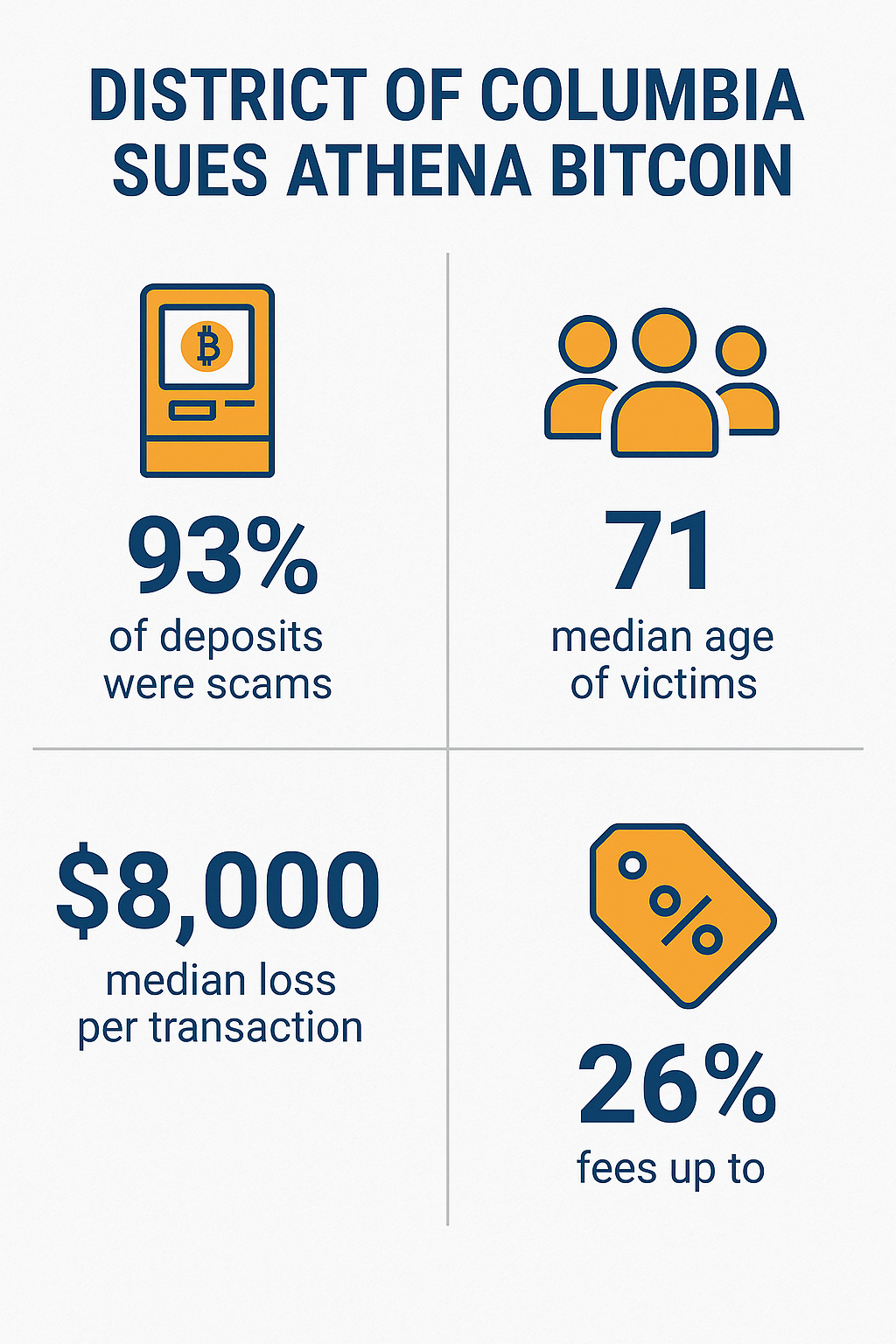
The lawsuit alleges that Athena’s ATMs in Washington, D.C., have been used for scams, particularly targeting seniors. The complaint states that within the first five months, 93% of deposits made at Athena’s D.C. ATMs were associated with fraudulent activity.
The lawsuit provides examples of the fraud schemes: scammers, usually abroad, reach out to victims claiming to be representatives of banks, government agencies, or tech support. They warn that the victim's bank account is at risk or that an “official investigation" requires cooperation. The victim is instructed to withdraw cash and deposit it into a Bitcoin ATM using a QR code provided by the scammer.
Once the money goes into the machine, Athena converts it into Bitcoin and sends it to the scammer’s digital wallet. From there, the funds can be quickly moved or cashed out overseas, making recovery almost impossible.
The District’s analysis indicates that the typical victim was 71 years old, and the average loss per transaction was approximately $8,000. Some residents lost their life savings in a single visit. One senior was scammed into depositing $98,000 into an Athena machine, while another lost $27,600 in just one transaction.
On top of the money stolen by scammers, Athena is accused of charging undisclosed fees as high as 26% per transaction. For comparison, most online services charge less than 3%.
For example, a victim deposited $10,000 into an Athena ATM when Bitcoin was roughly $59,936 per coin. However, Athena increased the price to $80,315, so the victim only received approximately $7,463 worth of Bitcoin. Athena retained the remaining $2,500 as its fee.
These fees were not clearly explained to customers. Instead, Athena hid them in confusing language or disguised them as part of the “exchange rate.” Many victims never realized how much they had been charged.
According to the lawsuit, when victims reached out to Athena after realizing they were scammed, the company reportedly claimed nothing could be done because cryptocurrency transactions are irreversible. However, Athena did not disclose that it had retained thousands of dollars in fees that could have been refunded.
The lawsuit argues that Athena broke the law in two major ways:
1. Deceptive and unfair practices under the Consumer Protection Procedures Act by hiding fees, misrepresenting refund policies, and operating without a money transmission license.
2. Financial exploitation of vulnerable adults under the Financial Exploitation Act by profiting from scams that specifically targeted seniors.
Additionally, from the lawsuit:
Despite clear data showing that its warnings do nothing to stop the imposter scams driving most of its revenue, Athena has continued operating unchanged—attempting to insulate itself behind ineffectual warnings and allowing its network of machines to grow into a pipeline for large-scale elder financial exploitation.
Read the entire complaint at: https://oag.dc.gov/sites/default/files/2025-09/2025-09-02-Athena-Complaint-FINAL-.pdf
